Sunday, January 16, 2022

Strength from weakness

 Strength from weakness

January Forest Church 2020

The theme for this session was "Exploring winter's beauty and strength with twigs and branches".
Winter seems to be a barren season for a tree. We too have barren seasons. We started with a short reflection Alistair had written for the session:
View up through overarching winter branches


Twig and Leaf

It's getting darker; colder.
The days grow short.

You struggle 
to photosynthesise,
struggle to be fruitful.

You are weary from insects,
ragged from storms.

You have one job to do,
one thing you are good at
and been faithful to pursue.

But now,
unfathomable changes far beyond you
undermine you.

So you surrender.
One by one you drop the leaves,
proud leaves, once beautiful,
marvellous leaves creating sugar
from the alchemy
of light and air.

But that time has long since gone
and so
you let it go.

Now you are naked, exposed, unfruitful.
Birds that once nested
in the shelter of your boughs
won't even roost
in the bleakness
of your nakedness.

You who have given so much for so long
have nothing left to give.

But you are twig,
connected into branch and bough
and trunk and root and tree.

Slow as the creeping winter stars,
sap stirs and nutrients from another world,
from deeper places than you know
seep into cells.
Buds swell,
bark strains.
The slow growth miracle 
begins again.  
 

Types of winter twigs and buds

David Chappell  had kindly brought a selection of twigs illustrating the way twigs and buds arrange - opposite, alternate and - like the oak - spiral. He also had examples of winterflowering twigs and a range of dogwoods whose colours brighten winter hedgerows even when leaves and flowers are absent.
 

The activity

 The options included 
  • walking around the garden at Fairwinds simply spending time noticing twigs and buds close up, a luxury we rarely afford ourselves,
  • collecting twigs and weaving the thin flimsy structures into strong and flexible mats,
  • touching and handling twigs from the large twig based mammal shelter by the compost heaps.
As the darkness came down there was something beautiful about hearing the murmer of voices in the garden against the background call of the rooks and the evening song of the blackbirds. We had benches arranged around the firebasket and many people shared their thoughts and experiences from the session. I loved listening to people speaking by firelight, recounting the different things they'd taken from their time of reflection. 
 
People sitting round a small fire basket in front of a treehouse, surrounded by winter shrubs. 
 
We ended up with refreshments and Terry's delicious baking (Tahini blondies and Chocolate brownies) on the decking / conservatory - all doors and windows open to minimise Covid! The younger people among us divided their attention between the cakes, the treehouse and the trampoline!
 
Really looking forward to the last of the Fairwinds-based winter sessions which Diana will be leading. More details to follow!
 
Alistair 

Sunday, September 12, 2021

Go to the ant thou sluggard; ...


September 2021 - Shepherd's Gutter, Furzley Lane

Introduction

The Bible encourages us to work hard, to plan ahead, to save against future lean times. It’s all true but like much of Scripture it holds its truth in a tension with opposing truths.

We are also told to give away, to be generous, to not worry about tomorrow. The man who was so pleased when he diligently filled all his barns was told ““You fool! This very night your life will be demanded from you. Then who will get what you have prepared for yourself?” (Luke 12.20). We’re told to hold possessions lightly so that “when you give to the needy, do not let your left hand know what your right hand is doing”.

When Martha complained about Mary skipping household duties to feed her soul on the words of Jesus, she was told “you’re worried and upset about many things but only one thing is needful. Mary has chosen the better part.”

We need help untangling these tensions. The creation around us is full of that help.

European Jay


Today our teacher is a bird that is more intelligent than most primates, can equal human toddler in some tasks and vastly exceed adult humans in others (like flying...).


True or false?

1. Jays understand the concept of food product “Use by Dates”.
2. Jays can tell the difference between a dead caterpillar and a twig of the same size and shape.
3. Jays store food near particular flowers – gorse and wild roses being favourites.
4. Over a million jays a year are killed across Europe as part of deliberate culling.
5. While some birds have dust baths, Jays like to bathe in living ants.
6. Jays can learn new tricks by watching the behaviour of other jays.
7. Humans are more susceptible to magic tricks than Jays

Jays are appear to combine the best of hardworking diligence and “planning for the future” with the best of unselfconscious generosity, a benevolence of anonymous abundance from which others benefit without ever knowing the source.

What does that mean for us?

How can we be unselfconsciously benevolent? How we can we turn storing and hoarding behaviour into blessings for others?

Find an oak tree. Enjoy it. Consider its history. Think about the Jay that might have planted it. Imagine what a great memorial that might be. Think about how you can be more Jay-like.

Monday, May 10, 2021

Summer blues

Dark blue English Bluebells with small flowers all on one side of the stalk. Long grass surrounds them.
For the May 2021 New Forest Forest Church reflection we used the emerging carpets of Bluebells in woodland to prompt our thinking on three themes:

  • Ghosts from the past  
  • A different way of measuring and
  • A different kind of strength.
The Summer Blues prompt materials are available as audio or text - if you're passing them on to friends you may prefer to use the short url - tinyurl.com/nffcmay21.

17 of us met online at the monthly zoom link and the conversation ranged widely. For me some of the key insights I got from the sharing included 
  • the idea of "rewilding the church" - the sense that - as bluebells are an echo of the ancient rich woodlands that are now lost; faithful people today continue to offer a glimpse of the rich and complex "wildwood" of faith and action, the legacy of great women and men and movements of the past. Just as ecologists are realising the importance of rewilding degraded landscapes, how do we rewild degraded faithscapes?
  • The value of connections - if you pick a bluebell (don't - they're protected species!) you'd only see the roots; not the fine filigree of fungal connections. Our invisible connections - perhaps to those who nurtured us in the past - need to be acknowledged and cherished. We also may have a role in mentoring and encouraging others, helping their roots grow and connect to the experience of God we have been blessed to know.
  • There was much sharing on the wonder - one called it holiness - of a space filled with bluebells and how we meeded to be mindful of these and other moments. One took 17 teddy bears to the woods for a daughter's Teddy Bear Picnic among the bluebells - a shared memory (and magic) that will likely last a lifetime.
  • The reflection on how to measure our remaining days by things like Bluebell seasons promoted the lovely phrase "intentional living".
  • Being "part of the solution, not part of the problem" led to some wide ranging thoughts and being "humble yet strong, without being a pushover" prompted some wise words about the "right to occupy the space in which we live and to defend it" - though there were many of us still grappling with how to make wise choices based on stewardship and responsibility.
There were many other contributions that will have meant different things to different people. I was grateful for the big and the small insights. None was less important - just like Bluebells are no less important than the trees they grow under. It was great to hear people's perspectives. Thank you.

Alistair McNaught - May 21
     

Sunday, January 17, 2021

Gorse - the winter hope

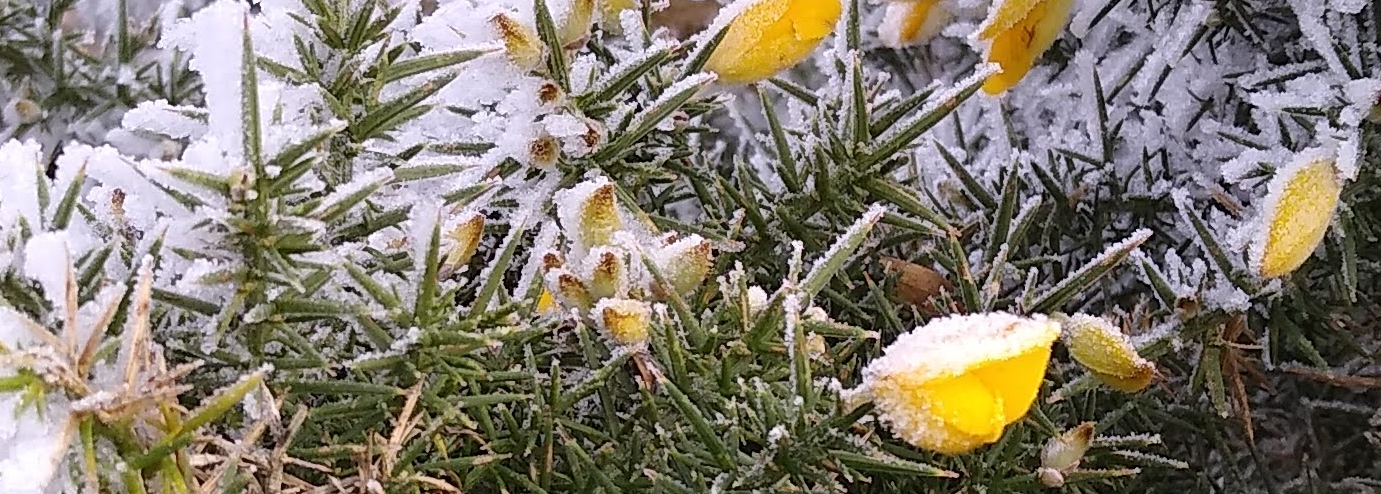
Gorse flowers dusted with thick, white hoar frost

For the January New Forest Forest Church reflection we explored Gorse - the spiky, defensive yet always sweetly flowering scrub layer of lowland heaths and acid soils.

There is more to gorse than meets the eye. Listen to (or read) the Gorse Tale. 

There is much to love about Gorse.

The way Gorse adapts to hardship (in its perennial quest for fruitfulness) has much to teach us. 

Here's the link to the reflection on Gorse. If you prefer a simpler url then it's tinyurl.com/nffcjan21

Alistair McNaught - January 2021

Monday, November 9, 2020

October session for Seed Gathering Sunday 11.10.20

Seed gathering Sunday


Question: When is the best time to plant a tree?


Answer: 20 years ago. The second best time is now.


For today’s material, I am grateful for Rachel Summer’s book ‘Wild Worship: discovering God through creation’.


Planting trees is an exercise in patience, Rachel reminds us. We plant for a future which we may or may not see ourselves, but we hope will benefit others, including perhaps our children and grandchildren. The seeds we gather today may be from trees which started growing before we were born. Rachel says, “All those tiny creatures that will have a home and thrive and multiply because of your tree. All the restful green beauty in the summer, and stark bony beauty in the winter, that you’ll be providing for the eyes of future generations. The shade from the sun and sudden downpours.”


So here’s the plan – 


·      You are invited to go for a walk somewhere there are trees, and look at their seeds and nuts. Maybe you will find acorns from oak trees, conkers from horse chestnuts, amongst many other types. Here is a link to a simple identification guide, if you would like one https://images.app.goo.gl/azP3FFpaHgsJ6KuC7

·      Place your hands on the trunks of the trees and give thanks for all they have given you over the past decades, and given others whom you don’t know

·      Choose some seeds that you would like to plant, and bring them carefully home. I know we usually try not to disrupt our landscape in Forest Church, but hopefully there will be plenty of seeds left behind, and you will be planting these baby trees in areas where they might not otherwise have the opportunity to grow

·      Once you are back at home, hold a seed in your hand and imagine the potential held within it. Imagine the tree growing through the years, the weather it will see, the animals it will shelter, the people who will enjoy looking at it, the oxygen it will create. Perhaps you might like to pray a prayer of thanks to God for the potential held in small and unassuming places. Pray for the lives the trees will touch, unknown to you now.

·      Use an old newspaper to create plant pots for sowing them in. Fold the sheet of newspaper in half. Place a baked bean tin or similar at the folded end, and roll the newspaper around it. Turn it on its end, and tap it, squashing the protruding newspaper underneath it. Carefully slide the tin back out, and fill the newspaper pot with soil. You could pack a few of them into an old ice cream tub to make it less messy when you water them. Plant a seed or two in each pot, label them, and put them somewhere cool over the winter to grow. Next year, you can plant the baby trees for your very own rewilding project. NB: there are lots of things to consider when choosing the site for your planting, e.g. proximity to buildings, rivers, power and pipelines, etc. Maybe we can have another Forest Church session to consider that in early spring!


Once you have planted your seeds, you might like to read this passage from Genesis chapter 1 in the Bible together –


Then God said, “Let the land produce vegetation: seed-bearing plants and trees on the land that bear fruit with seed in it, according to their various kinds.” And it was so. 12 The land produced vegetation: plants bearing seed according to their kinds and trees bearing fruit with seed in it according to their kinds. And God saw that it was good.


One final idea – look at this poem – do you think the poet has deliberately written it in the shape of a tree? Or is that just my imagination? Perhaps you might feel inspired to create your own piece of art or poetry.


Think Like a Tree

by Karen I. Shragg

Soak up the sun
Affirm life’s magic
Be graceful in the wind
Stand tall after a storm
Feel refreshed after it rains
Grow strong without notice
Be prepared for each season
Provide shelter to strangers
Hang tough through a cold spell
Emerge renewed at the first signs of spring
Stay deeply rooted while reaching for the sky
Be still long enough to
hear your own leaves rustling.


Friday, November 6, 2020

Autumn Leaves - Detachment


Following current government guidelines, we will not be gathering this month. However, as usual, we have created material for you to go either alone or with your bubble into a natural space and follow the thoughts for this month. Just as we did last month, we will be gathering via Zoom on Sunday evening to still meet and talk about our experiences and thoughts.


New Forest Forest Church for November 8th 2020 can be found here:
http://www.waymarkministries.com/forest-church.html 

Friday, August 7, 2020

Hedgerow Walk

 Usually New Forest Forest Church meet together on the second Sunday of the month. However, during the lockdown we have been producing material on those Sundays for each of us to go out into the natural world around us either alone, or in our household/bubble.

This month New Forest Forest Church will be walking local hedgerow.
Hedgerow is a significantly important aspect of the ecosystem, and is in decline in Britain.

We will each walk whichever hedgerow we find to walk and stop to look at the vast array of life that can be found in it. Not only the creatures, but the plants themselves.
There is a very rough guide which can be followed by which a hedgerow can be aged. This is done by counting the number of woody species, trees and large shrubs, within a 30m length of hedgerow. Each species counted equals around 100 years of age, so the more species you find, the older the hedgerow is!
The second guide to discovery in the hedgerow is "the more you look, the more you see". Take time to pause at points along the hedgerow and just stare into it.
The longer you stand and stare the more life you will discover is there.

Why not record, write, draw, or photograph, the different species and types of plant you discover and guess the age of the hedgerow; and the different species and types of creature you discover and write them out on the Facebook page or blog post?

Below are a couple of websites to give you some more information.

As you walk the hedgerow keep these verses in mind:

And God said, “Let the earth bring forth living creatures of every kind: cattle and creeping things and wild animals of the earth of every kind.” And it was so.
Genesis 1v24


13 From your lofty abode you water the mountains; the earth is satisfied with the fruit of your work.
14 You cause the grass to grow for the cattle, and plants for people to use, to bring forth food from the earth,
15 and wine to gladden the human heart,
oil to make the face shine, and bread to strengthen the human heart.
16 The trees of the Lord are watered abundantly, the cedars of Lebanon that he planted.
17 In them the birds build their nests; the stork has its home in the fir trees...
...24 O Lord, how manifold are your works!
In wisdom you have made them all;
the earth is full of your creatures.
Psalm 104v13-17 & 24


After you have walked the hedgerow and contemplated the verses, think of how you might be able, in any little or significant way, to help the growth of hedgerow, and the life of plant and creature within it.

https://www.wildlifetrusts.org/habitats/farmland/hedgerow

https://www.countryfile.com/wildlife/trees-plants/hedgerow-plants-and-flowers-guide-how-to-identify-common-species/


Thursday, July 9, 2020

The Parable of the.... Rose Family Fruits

July brings the start of the main summer harvest in our garden and, although strawberries and some raspberries have fruited, now there are all the currants, plenty of raspberries, loganberries and tayberries and even the blackberries are starting to turn red, ready for an August picking.

Cherries are safely picked and turned into pie and jam; apples and pears are swelling in the orchard and the crab apple tree is so laden we have to stoop to walk under it. Even our baby plum tree has a few ripe fruit for the first time ever.

This month we are using these summer fruits as a basis for our Forest Church, taking a slightly different angle on the parable of the sower. This time the seeds are not being planted straight in the ground, we are considering their growth even before harvest time, as they are growing to maturity in their parent plant.

Join us as we muse together on how we allow God's word (these same seeds) to grow in us to maturity.

There is a link to an audio file and also a simple video for those who like pictures to focus on.

Please add your comments and thoughts below when you have had a chance to participate in this month's Forest Church - I am only sorry I can't share with you the real fruit from our garden that I had hoped would be part of this session!

Audio Podcast (MP3) of July's Forest Church


Wednesday, June 10, 2020

Wind, wind, blow on me...


Image of a crow in a treeThis month's forest church is about getting outside and listening; listening to the wind (or the rain) and the language of air and water.

The Holy Spirit is sometimes described as Living Water and Jesus said of the Spirit  "The wind blows wherever it pleases. You hear its sound, but you cannot tell where it comes from or where it is going. So it is with everyone born of the Spirit." 

So here's a story to get you going and some further instructions based on the story. 


Click here to open the story (mobile-friendly podcast with transcript).
Let us know your own reflections by commenting on this post.

Saturday, May 9, 2020

Is Coronavirus healing the Earth?


This month for New Forest Forest Church, rather than a video, we felt that it would be nice to all go out in our local area at 4 o’clock on Sunday May 10th, when we would usually be gathering, so that we are all out at the same time, even if we aren’t together, and as we walk to contemplate how the current lockdown is affecting the planet and the natural environment.


As you walk slowly and quietly and absorb the natural environment near you and the Divine presence within it, contemplate what impact your life has on the planet, and what the current situation shows us about the affect Western culture is having on the earth.

Below is some information to help your thoughts. Perhaps you could find out more information.

Following your time out contemplating, why not come back here and write your thoughts and comments so that we can share together in our experiences?

While the world grapples with the coronavirus pandemic, the slowdown in human activity is having some unexpected, but positive impact on our planet. To combat the rapidly spreading virus countries have put a lockdown resulting in limited travel and industrial activity.
Across the globe wildlife and plant life and aqua-life has been reported as increasing in its health and activity. Limiting travel has led to a reduction in vehicle emissions and cutting the amount of industrial activity has led to a drop in the number of harmful particles put in the air and water.
According to Lauri Myllyvirta, an analyst at the Centre for Research on Energy and Clean Air in Finland, the restrictions contributed to a 25 percent drop in China's carbon dioxide emissions over four weeks beginning in late January, compared to the same time last year.
Myllyvirta's analysis also found that industrial operations were reduced by 15 percent to 40 percent in some sectors and that coal consumption at power plants fell by 36 percent.
In San Francisco, which is under shelter-in-place orders to control the spread of the coronavirus, the average concentration of fine particulate matter — tiny particles in the air that are dangerous because they can be breathed deeply into the lungs — over five days was almost 40 percent lower than the previous year; in New York City, there was a 28 percent drop over the same period of time, and the Seattle-Tacoma-Bellevue saw a 32 percent decrease.
Air pollution levels in the UK dropped significantly in the first two weeks that the country went into lockdown to stop the spread of coronavirus. Some UK cities saw nitrogen dioxide (NO2) levels fall by up to 60%, analysis shows. NO2, released from car exhausts, is a serious air pollutant and also indirectly contributes to the warming of the planet.
Researchers who study the Earth’s movement are reporting a drop in seismic noise — the hum of vibrations in the planet’s crust — that could be the result of transport networks and other human activities being shut down. Data from a seismometer at the Royal Observatory of Belgium in Brussels, show that measures to curb the spread of COVID-19 in Brussels caused human-induced seismic noise to fall by about one-third.

Watch this video to learn more: https://www.youtube.com/watch?v=hxy5sBe2o5k